

Culture
The history of the As de Oros (coins): the most important card in the Spanish deck
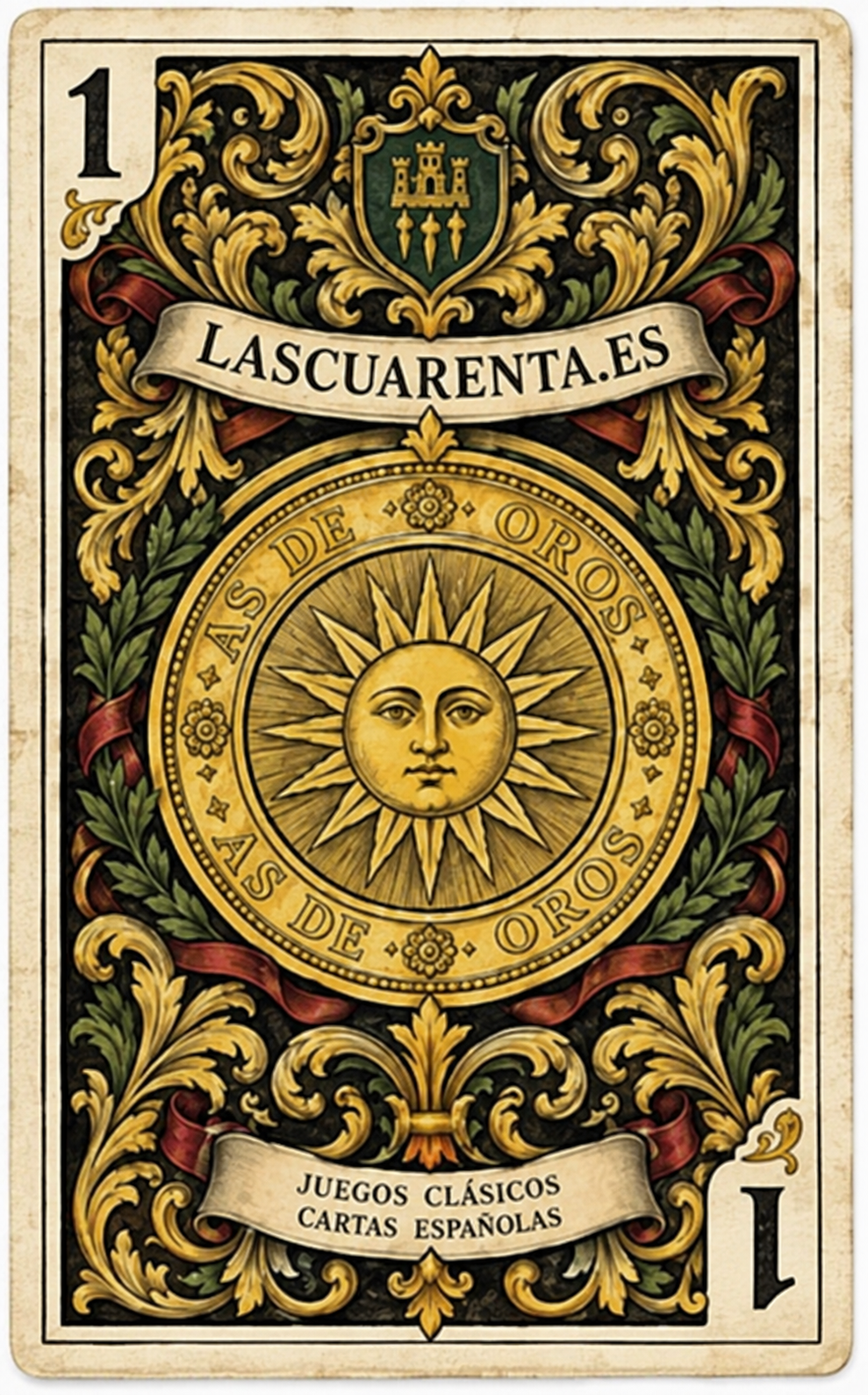
The As de Oros (coins) (Ace of Gold coins) is a familiar part of Spanish popular culture and a card many people would probably name first when shown a Spanish deck. For generations, it has appeared in bars, casinos and family gatherings, in games of Mus, Tute, Brisca and Guiñote.
But the curious thing is that the As de Oros did not become famous by chance. Behind that large golden coin lie several centuries of history, taxes, card manufacturers, symbols of power, and even some secrets that many players are unaware of.
What does the Oros suit really represent?
The Oros [Gold coins] are one of the four traditional suits of the Spanish deck, alongside Copas (cups) [Cups], Espadas (swords) [Swords], and Bastos (clubs) [Clubs]. Although today we associate them simply with money, their roots are much older.
Historians believe that playing cards reached Europe via Mediterranean trade routes, originating from Oriental models that already used symbols related to coins and wealth. Over time, those representations evolved into the Oros we know today.
In fact, the Oros suit has maintained a direct link with the concept of money for centuries. In many historical interpretations, it has been associated with commerce, wealth, and economic activity, in contrast to Espadas (the nobility and war), Copas (the clergy), and Bastos (the working people).
Why is the As de Oros so special?
Unlike other cards, the As de Oros always had an additional function beyond the game itself.
For centuries, manufacturers took advantage of this card to place their signature, their brand name, and various identifying elements. It was the perfect card because its large central coin offered plenty of free space to include coats of arms, names, stamps, or decorations.
That is why, when collectors study an old deck, one of the first cards they look for is precisely the As de Oros. It often allows them to identify who manufactured the deck, where it was printed, and even the era in which it was produced.
The era when the State monitored playing cards
There was a time when manufacturing playing cards was not as simple as printing cards and selling them.
For centuries, there were specific taxes on decks. Manufacturers had to prove they had paid the corresponding fees, and the most practical way was to include certain official marks on the As de Oros.
For that reason, this card became a sort of identity document for each deck. Stamps, coats of arms, administrative references, or fiscal marks certifying its legality could appear there.
When these taxes disappeared, the space did not remain empty. Manufacturers continued to use it to include their own emblems and logos.
The Fournier As de Oros: the one almost everyone recognises
If you think of an As de Oros today, you are probably imagining the design popularised by Fournier.
At the end of the 19th century, Heraclio Fournier revolutionised the design of the modern Spanish deck. His models gained international recognition and eventually became the visual standard that millions of people identify as "the lifelong Spanish deck".
One of the best-known curiosities is that Heraclio Fournier himself came to be represented on the As de Oros of some of his historical decks. Over time, that image ended up becoming one of the most recognisable hallmarks of the brand.
That is why, even today, many people automatically associate the As de Oros with the classic Fournier image, even though there are numerous different regional models and patterns.
A card that goes beyond the game
The As de Oros hasn't just been important at the gaming tables.
It has also appeared in advertising posters, illustrations, collectors' items, museums, and even in commemorative decks dedicated to historical events or famous figures.
In some special editions, the large central circle has been used as a space to display monuments, coats of arms, political symbols, or cultural references from different eras.
In other words, the As de Oros has often functioned as a small front cover within the deck itself.
Is it the most important card in the Spanish deck?
The answer depends on the game.
In many traditional Spanish games, the value of the cards varies according to the rules, so the As de Oros is not always the strongest card in terms of points.
However, from a historical and cultural point of view, few cards can compete with it.
It has been the card chosen to display brand names, pay taxes, exhibit coats of arms, identify manufacturers, and represent the very concept of the Spanish deck. While other cards barely changed, the As de Oros accumulated functions and meaning.
Perhaps that is why, when someone thinks of a Spanish deck, they usually imagine that large decorated coin before any Rey [King], Caballo [Knight/Horse], or Sota [Jack/Knave].
A small card with a lot of history
The next time you have an As de Oros in your hand, it is worth looking at it closely.
Behind that apparently simple drawing lie more than six hundred years of card evolution, changes in printing systems, royal taxes, legendary manufacturers, and popular customs that have survived generation after generation.
In the end, the As de Oros is much more than a card. It is one of the most recognisable pieces of Spanish gaming culture and a small illustrated summary of the history of our deck.