

Spanish deck
Who invented the Spanish deck?
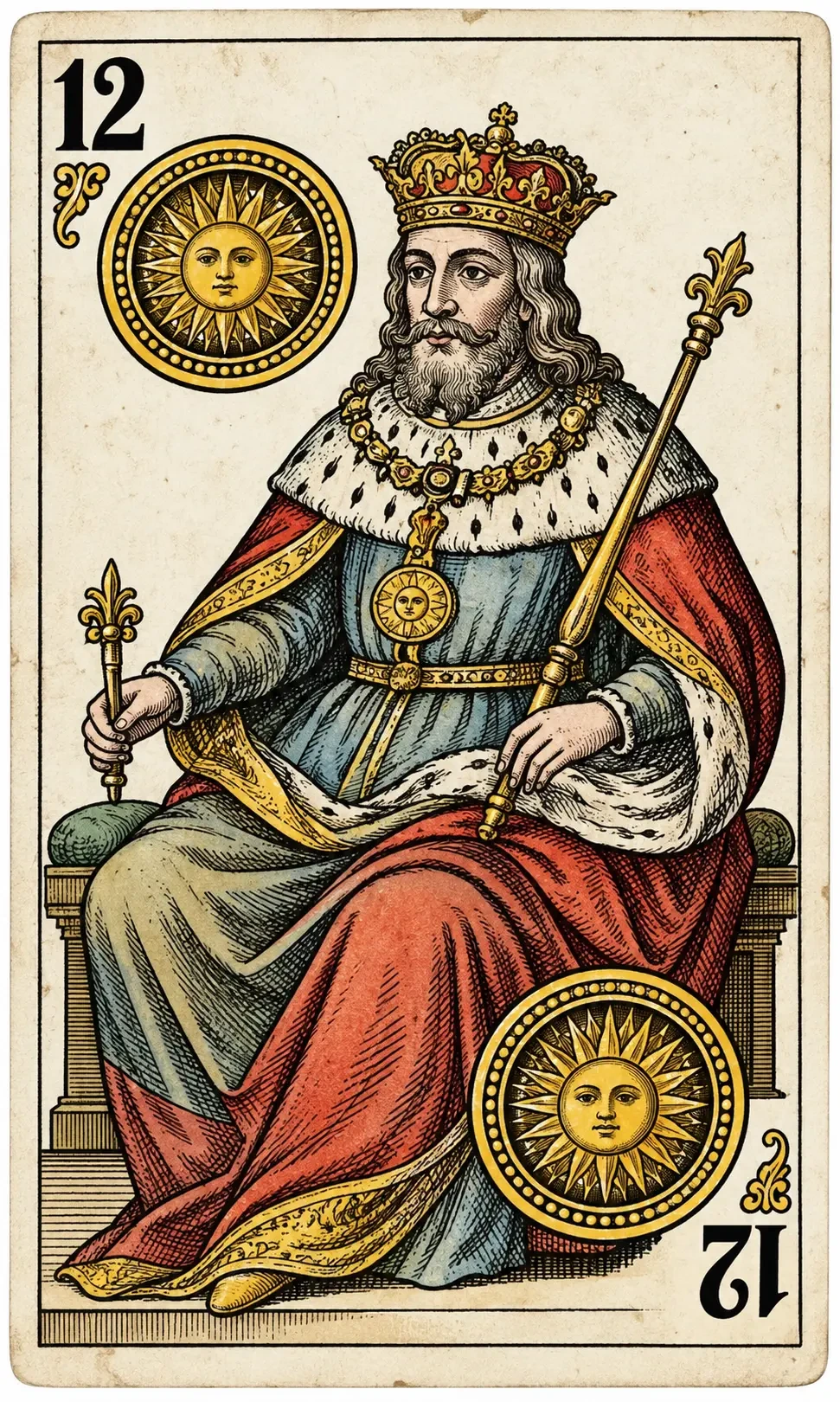
The Spanish deck has no single inventor: it developed over centuries after playing cards reached the Iberian Peninsula in the 14th century, likely from Mamluk Egypt. Its best-known modern appearance took shape in the workshops of Heraclio Fournier in Vitoria at the end of the 19th century.
An object from afar
The oldest playing cards we know of are Chinese, but the key link for Europe is the Mamluk deck, featuring suits of coins, cups, swords, and polo sticks. A deck of this type is preserved in the Topkapi Museum in Istanbul. If those four suits sound familiar, it is no coincidence: they are the ancestors of Oros (gold coins), Copas (cups), Espadas (swords), and Bastos (clubs). We explain this in depth in how playing cards arrived in Spain.
The first clues in the Peninsula
In 1371, the word naip appeared in a Catalan rhyming dictionary by Jaume March, and throughout the following decades, playing cards began to appear in prohibitions and ordinances. The fact that playing was banned is the best proof that people were doing it. The Spanish word "naipe" (playing card) itself is often linked to the Arabic nā'ib, meaning "deputy" or "lieutenant", though the exact origin is still debated.
Centuries of changes
Every workshop and every era added its own touch. The male court figures were established (Sota, Caballo and Rey — respectively the Jack, Knight, and King), the Queen disappeared, and the suits took their current form. The "pinta" (border) was also born: these are breaks in the frame of the card that tell you the suit without having to fully reveal the card.
And what about Heraclio Fournier?
Fournier did not invent the deck, but he did make it popular throughout Spain. From 1868, he printed cards in Vitoria, and his 1889 design, with illustrations by Augusto Rius, became the image that almost all of us have in mind. At Lascuarenta, we use our own decks to avoid copying that design, such as our baraja antigua (antique deck).
Sources
Frequently asked questions
Is the Spanish deck the oldest in Europe?
It is among the first, along with the Italian deck; both descend from the same model of Latin suits.
Did Fournier invent the Spanish deck?
No. He industrialised it and popularised its design at the end of the 19th century.